
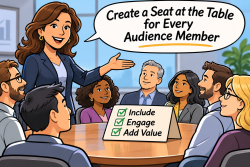
Create a Seat at the Table for Every Audience Member
“Connection is why we’re here; it is what gives purpose and meaning to our lives.”
— Brené Brown — research professor and authorHappy Thanksgiving to my loyal readers. I hope you and yours have a safe, restful, and family Thanksgiving.
Thanksgiving reminds us that everyone deserves a seat at the table.
The same principle applies to your technical presentations. Your guests at the table are your audience members.
You must ensure every audience member feels welcomed, understands your message, and has an opportunity to contribute.
Below are three ways to do this:
Set the Table: Know Who You’re Inviting
At family Thanksgiving meals, we take great joy in finding all the new things in our guests’ lives over the past year. But you have to know a few things about them before you can ask your questions.
Likewise, when you deliver a technical presentation. It behooves you to learn who your audience is before you start preparing slides and practicing your presentation.
Are you speaking to a technical, non-technical, or combination audience? What does your audience know about your subject? What is your audience’s opinion of your subject?
Ask about your audience’s priorities and expectations. I ask the audience two questions right before I deliver my presentation.
What frustrates you most about creating, practicing, and delivering a technical presentation? What would make this time we have together successful for you?
Audience answers to these two questions give me great insight. Their technical presentation frustrations and criteria for a successful presentation then become my contract with the audience. I concentrate on these because my audience has told me they are interested in these.
Since you know your audience well, you know the language they can understand. Watch your use of jargon. There may be some in your audience that understand it, but changes are some won’t.
Remember, your job is to clearly present your material. Your audience decides whether your presentation is clear. You can tell from your audience’s body language whether it is clear.
Use common examples and analogies to make your points clear. Comparing what you are saying and showing in your slides to what your audience already knows goes a long way toward helping them understand your message.
Don’t forget to emphasize how what you are delivering affects their personal and professional lives. Your audience is most interested in this.
One way to create a seat at the table for every audience member is to set the table and know who you are inviting (your audience members).
Another way is to serve the feast of your technical presentation so you are delivering something for everyone.
Serve the Feast: Deliver Something for Everyone
Like a newspaper column, always lead with your main conclusion. Then add detail as needed and as time allows.
Your conclusions are the “meat and potatoes” for which your audience is yearning. Don’t make them wait.
It is always best to support your conclusions with relevant fact-based evidence. Use evidence that is hard to refute. Factual evidence everyone can agree on is powerful. Use this power to emphasize your message.
Don’t fall into the trap of getting too detailed. Save complex details for deeper discussion at a break or for follow-on discussions.
As an engineer, I can say we love details. But the details you are interested in may not be as interesting to your audience. It is always best to have your audience ask for more details.
Make sure you keep everyone engaged. Use stories to illustrate technical concepts. Incorporate clear visuals and analogies. Invite audience participation throughout your presentation.
Avoid overloading audience members’ “plates.” Present one major idea at a time. Also, fully state when you are moving on to the next major idea.
Ruthlessly review your slides to ensure they are absolutely necessary. If they are, review each slide to determine whether everything on each slide is necessary.
Pauses are powerful rhetorical devices. They give your audience time to digest what you are saying and showing. They also provide a “muscular” way to emphasize points in your presentation. Pause often to reinforce important takeaways.
Two ways to create a seat at the table for every audience member are to set the table and know who you are inviting (your audience members) and serve the feast of your technical presentation by delivering something for everyone.
A third way is to share your gratitude with your audience by making every voice count.
Share the Gratitude: Make Every Voice Count
Encourage questions from all participants. In fact, invite them to co-present. This means fully inviting them to express their personal experiences on your topic.
Be secure enough to welcome challenges and alternative viewpoints. This is a guaranteed way to keep your audience’s interest in your topic.
Allow sufficient time for thoughtful responses. Your job is not to show how much you know. It is to plant the seed in audience members so they can express themselves on the topic.
Give everyone an equal chance to contribute. Avoid letting one person dominate. Invite input from quieter audience members.
Listen without interrupting or judging. You may have a propensity to interrupt people when they are talking. Quell this propensity until the audience member is finished.
This is not to say you should allow an audience member to run on. You may have to interrupt in the interest of time. However, if at all possible, allow audience members to finish their thoughts.
Summarize the key conclusions at the end and give your audience a call to action—what do you want them to do as a result of your technical presentation? Let them know their next steps.
Ensure you thank the participants. Participants make your technical presentation so much more enriching for everyone, including you.
Three ways to create a seat at the table for every audience member are to (1) set the table and know who you are inviting (your audience members), (2) serve the feast of your technical presentation by delivering something for everyone, and (3) share your gratitude with your audience by making every voice count.
A successful Thanksgiving dinner isn’t measured by how much food you serve, but by how welcome and satisfied your guests feel.
Likewise, a successful technical presentation isn’t measured by how much information you deliver, but by how well your audience understands, participates, and acts on your message.
Serve a feast at your next technical presentation!
Call to Action
Before you start your presentation, ask your audience the following two questions: What frustrates you most about the topic of this presentation? What would make this time we have together successful for you?
Save complex details for deeper discussion at a break or for follow-on discussions. Don’t fall into the trap of getting too detailed.
Be secure enough to welcome challenges and alternative viewpoints. This is a guaranteed way to keep your audience’s interest in your topic.
“If you talk to a man in a language he understands, that goes to his head. If you talk to him in his language, that goes to his heart.”
— Nelson Mandela — Former President of South Africa and Nobel Peace Prize Laureate___________________________________
References
Duarte, Nancy. (2012). HBR Guide to Persuasive Presentations. Harvard Business Review Press. Covers audience analysis, eliminating jargon, and engaging diverse audiences. Book reference.
Anderson, Chris. (2013, June). “How to Give a Killer Presentation.” Harvard Business Review. Explains storytelling, effective delivery, and audience connection. Read article.
Mayer, Richard E. (2020). Multimedia Learning (3rd ed.). Cambridge University Press. Provides research-based principles for reducing cognitive overload and improving comprehension. Book reference.
Edmondson, Amy. (1999). “Psychological Safety and Learning Behavior in Work Teams.” Administrative Science Quarterly, 44(2), 350–383. Explores creating environments where individuals feel safe contributing ideas and asking questions. Read research.
CAST. (2024). Universal Design for Learning Guidelines, Version 3.0. CAST. Provides principles for inclusive engagement, accessible information, and multiple opportunities for participation. View guidelines.
___________________________________
Being a confident, engaging, and effective STEM speaker is a vital personal and professional asset. With more than 40 years of engineering experience and more than 30 years of award-winning public speaking experience, I can help you reduce your presentation preparatory time by 50%, overcome your fear of public speaking and be completely at ease, deliver your presentations effectively, develop your personal presence with your audience; and apply an innovative way to handle audience questions deftly.
Working closely with you, I provide a customized protocol employing the critical skills and tools you need to create, practice, and deliver excellent STEM speeches and presentations. Let’s connect and explore how I can help you become the exceptional speaker you were meant to be. Please reach out to me at fr***@*****************ed.com or 703-509-4424 for a complimentary consultation. Schedule a meeting with me at calendly.com/frankdibartolomeospeaks
.©2026 DiBartolomeo Consulting International (DCI), LLC. All Rights Reserved. May not be used without permission.