
How to Manage Time During Your Technical Presentation
“Perfection is achieved, not when there is nothing more to add, but when there is nothing left to take away.”
— Antoine de Saint-Exupéry — French Writer and AviatorTechnical presentations often run overtime because engineers and other technical professionals try to explain too much information in too little time.
Effective time management means prioritizing essential information, rehearsing your delivery, and controlling your presentation’s pace.
Below are three ways to manage your time during your technical presentations.
Plan Your Presentation Around the Available Time
Identify the most important information your audience needs to understand.
Focus on the technical findings, recommendations, and decisions that matter most to your audience rather than explaining every detail of your work.
The theme of knowing your audience comes up a lot in these newsletters. Knowing what your audience wants and needs will help you cut parts of your technical presentation that aren’t of interest.
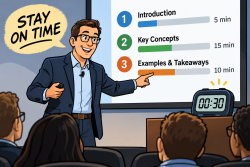
Divide your available time into clearly defined sections. Allocate sufficient time for your introduction, main points, conclusion, and audience questions so no single section dominates your presentation.
Time the opening, body, and closing of your technical presentation separately. Allot each part a maximum time and then practice these parts separately until you comfortably stay within time limits. Allot the maximum time to the body of your presentation.
Prepare supporting technical details without including all of them in your presentation. Place complex calculations, extensive data, and supplementary explanations in backup slides or handouts that you can reference when necessary. Use hyperlinks to backup slides for those audience members who want to dig deeper.
One way to manage time during your technical presentation is to plan your presentation around the available time.
Another way is to practice and rehearse to stay within your time limit.
Practice and Rehearse to Stay Within Your Time Limit
Rehearse your complete presentation using a timer.
Practice aloud under realistic conditions to determine whether your material fits comfortably within the allotted time.
If you go over time, ask yourself two questions: “What can I delete from the presentation without diluting my message?” and “How can I reduce the words I say without diluting my message?
Identify sections that consistently take longer than expected. Often, technical speakers spend an inordinate amount of time on one main point and minimal time on the other main points.
This gives your audience the impression that the point you spend more time on is more important than the others. Strive to spend approximately the same time on each main point.
Simplify complicated explanations, eliminate unnecessary examples, and reduce repetitive information without sacrificing technical accuracy.
Determine if what you are saying supports your main message. If it doesn’t, delete it from your presentation.
Establish specific time checkpoints throughout your presentation. Know approximately when you should finish each major section so you can recognize delays early and make adjustments before running out of time.
Two ways to manage time during your technical presentation are to plan around the available time and practice to stay within your time limit.
A third way is to control your speaking pace and manage interruptions.
Control Your Speaking Pace and Manage Interruptions
Speak at a deliberate pace that allows your audience to absorb technical information.
Slow down when explaining complicated concepts, introducing unfamiliar terminology, or emphasizing important conclusions.
Speed up when explaining information that is familiar to your audience. You will be respecting your audience’s time if you do.
Manage audience questions without allowing them to consume your presentation time. Answer brief clarification questions immediately, but reserve lengthy discussions and detailed technical questions for a designated Q&A period.
Clarifications are a great way to read your audience. Are they getting what you are saying, or are they completely lost?
Prepare a shorter version of your presentation in case time becomes limited. Identify which examples and supporting details you can omit while preserving your essential message, recommendations, and conclusion.
If you are one of a series of presenters and scheduled to speak later in the day, you can almost count on being asked to shorten your technical presentation. It is better to be ready for this.
Three ways to manage time during your technical presentation are to (1) plan around the available time, (2) practice to stay within your time limit, and (3) control your speaking pace and manage interruptions.
Managing presentation time is not about speaking faster. It is about selecting the right information, rehearsing effectively, and delivering your most important message before time runs out.
Become a master time manager of your technical presentations!
Call to Action
Focus on the technical findings, recommendations, and decisions that matter most to your audience rather than explaining every detail of your work.
Establish specific time checkpoints throughout your presentation. Know approximately when you should finish each major section so you can recognize delays early and make adjustments before running out of time.
Prepare a shorter version of your presentation in case time becomes limited. Identify which examples and supporting details you can omit while preserving your essential message, recommendations, and conclusion.
“Time is the scarcest resource. Unless it is managed, nothing else can be managed.”
— Peter Drucker — Management Consultant and Author___________________________________
References
Massachusetts Institute of Technology (MIT), Electrical Engineering and Computer Science Communication Lab. “Slide Presentation,” CommKit. Explains how to organize technical presentations around a central purpose, limit each slide to one primary message, and prepare backup slides for technical questions. Read MIT guidance. mitcommlab.mit.edu
Toastmasters International. “Manage Your Speaking Time,” Toastmaster Magazine, February 2025. Discusses the importance of respecting presentation time limits, practicing aloud, and preparing presentations that fit their allotted duration. Read article.
MIT, Nuclear Science and Engineering Communication Lab. “Delivery and Q&A,” CommKit. Recommends rehearsing early, timing transitions, controlling speaking pace, and preparing for audience questions. Read MIT guidance. mitcommlab.mit.edu
Toastmasters International. “25 Ways to Nail Your Workplace Presentation,” Toastmaster Magazine, May 2018. Advises speakers to rehearse in real time, focus on their central message, and remove content rather than accelerate delivery when running overtime. Read article.
Joel Schwartzberg. “10 Ways to Prepare for a Work Presentation,” Toastmaster Magazine, March 2026. Provides practical guidance on defining a presentation’s main point, eliminating unnecessary material, and rehearsing aloud to improve clarity and efficiency. Read article.
___________________________________
Being a confident, engaging, and effective STEM speaker is a vital personal and professional asset. With more than 40 years of engineering experience and more than 30 years of award-winning public speaking experience, I can help you reduce your presentation preparatory time by 50%, overcome your fear of public speaking and be completely at ease, deliver your presentations effectively, develop your personal presence with your audience; and apply an innovative way to handle audience questions deftly.
Working closely with you, I provide a customized protocol employing the critical skills and tools you need to create, practice, and deliver excellent STEM speeches and presentations. Let’s connect and explore how I can help you become the exceptional speaker you were meant to be. Please reach out to me at fr***@*****************ed.com or 703-509-4424 for a complimentary consultation. Schedule a meeting with me at calendly.com/frankdibartolomeospeaks
.©2026 DiBartolomeo Consulting International (DCI), LLC. All Rights Reserved. May not be used without permission.