
How Engineers Can Communicate Uncertainty Without Sounding Uncertain
“When you can measure what you are speaking about, and express it in numbers, you know something about it.”
— William Thomson, Lord Kelvin, was one of the most influential physicists and engineers of the 19th centuryEngineers routinely work with probabilities, assumptions, incomplete data, forecasts, simulations, and technical risk.
The challenge is to acknowledge what is unknown while remaining clear about what should be done.
Research on risk communication consistently supports communicating uncertainty rather than hiding it—but tying that uncertainty directly to its significance for the decision.
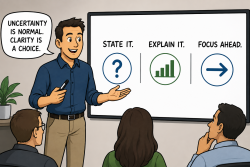
Below are three ways you can communicate uncertainty without sounding uncertain.
Separate What You Know From What You Don’t Know
Lead with what is known. Start with the strongest evidence before discussing limitations: “The testing shows a consistent 15% improvement across all three configurations.” This establishes the factual foundation before introducing uncertainty.
Define the uncertainty precisely. Replace vague qualifiers such as maybe, possibly, probably, and I think with specific information: “The estimate is between 12% and 18%, with the variation primarily driven by operating temperature.”
Distinguish important uncertainty from technical noise. Research shows that how you present probabilities and ranges can materially affect how audiences interpret risk.
Executives usually do not need every modeling limitation. Identify which assumptions could actually change the decision; sensitivity analysis can help determine which uncertainties matter most.
Discuss how uncertainty will be reduced in the future—present detailed plans of how and when this will be done and who will determine how to do this.
One way you can communicate uncertainty without sounding uncertain is to separate what you know from what you don’t know.
Another is to connect uncertainty to its impact on the decision.
Connect Uncertainty to Its Impact on the Decision
Explain what the uncertainty means. Don’t stop at “There is a 20% uncertainty in our forecast.” Follow immediately with the consequence: “Even at the lower end of our forecast, the project meets the required performance threshold.”
Use scenarios when appropriate. Present a concise range such as expected case, downside case, and upside case, showing the decision implications of each. This turns uncertainty from an abstract statistical issue into information executives can use.
Identify what would change your recommendation. Say, for example: “Our recommendation remains Option A unless demand falls below 40,000 units annually.”
This is especially powerful because it acknowledges uncertainty while showing you understand the decision boundary.
Risk-informed decision frameworks explicitly incorporate uncertainty when evaluating alternatives, rather than treating it as a reason to avoid deciding.
Two ways you can communicate uncertainty without sounding uncertain are to separate what you know from what you don’t know and connect uncertainty to its impact on the decision.
A third way is to make a clear recommendation despite the uncertainty.
Make a Clear Recommendation Despite the Uncertainty
State your recommendation directly. After presenting the evidence and uncertainty, say: “Based on the evidence available, I recommend Option A.” Avoid ending with “It depends,” unless you immediately explain exactly what it depends upon.
State your confidence level. Consider language such as: “I have high confidence in the direction of the recommendation, although the exact cost savings remain uncertain.” This separates confidence in the decision from forecast precision—two very different things.
Explain the next step for reducing uncertainty. Conclude with action: “We recommend proceeding with the pilot while collecting another 60 days of operating data.”
Good engineering judgment doesn’t eliminate uncertainty—that is usually impossible. It is determining whether you have enough information to make a defensible decision now.
A useful communication formula: What you know → What you don’t know → Why it matters → What I recommend → What we’ll monitor
That structure allows you to say, in effect, “The numbers contain uncertainty; my recommendation does not.”
Three ways you can communicate uncertainty without sounding uncertain are to (1) separate what you know from what you don’t know, (2) connect uncertainty to its impact on the decision, and (3) make a clear recommendation despite the uncertainty.
Uncertainty will always be present in any project. Connecting uncertainty to decisions and planning for what to do if it turns negative shows an engineer proactively managing uncertainty.
Be that type of engineer.
Call to Action
Distinguish important uncertainty from technical noise. Research shows that how you present probabilities and ranges can materially affect how audiences interpret risk
Explain what the uncertainty means.
Explain the next step for reducing uncertainty. Conclude with action.
“The world doesn’t have the luxury of waiting for complete answers before it takes action.”
— Daniel Gilbert is a Harvard psychology professor known for his research on decision-making and predicting future outcomes___________________________________
References
National Research Council. Improving Risk Communication. National Academies Press, 1989. The report recommends explicitly disclosing meaningful uncertainties, data gaps, confidence levels, and disagreements while avoiding both minimizing and exaggerating uncertainty.
Institute of Medicine. Environmental Decisions in the Face of Uncertainty. National Academies Press, 2013. Chapter 6 examines how uncertainty should be communicated in decision-making, including confidence, risk estimates, audience characteristics, and the effect uncertainty has on decisions.
Spiegelhalter, David. “Risk and Uncertainty Communication.” Annual Review of Statistics and Its Application, Vol. 4, 2017, pp. 31–60. Reviews methods for communicating numerical risk, probabilities, verbal expressions, graphics, and deeper forms of uncertainty.
Sudret, Bruno; Podofillini, Luca; and Zio, Enrico. “Treatment of Uncertainty in Risk and Reliability Modeling and Decision-Making.” ASCE-ASME Journal of Risk and Uncertainty in Engineering Systems, Vol. 5, No. 3, 2019. Emphasizes that uncertainty modeling, decision-making under uncertainty, and communication of uncertainty should be integral to engineering risk management.
NASA. NASA Risk-Informed Decision Making Handbook, NASA/SP-2010-576, 2010. Provides a structured framework for evaluating alternatives and making engineering and program decisions when significant uncertainty exists.
___________________________________
Being a confident, engaging, and effective STEM speaker is a vital personal and professional asset. With more than 40 years of engineering experience and more than 30 years of award-winning public speaking experience, I can help you reduce your presentation preparatory time by 50%, overcome your fear of public speaking and be completely at ease, deliver your presentations effectively, develop your personal presence with your audience; and apply an innovative way to handle audience questions deftly.
Working closely with you, I provide a customized protocol employing the critical skills and tools you need to create, practice, and deliver excellent STEM speeches and presentations. Let’s connect and explore how I can help you become the exceptional speaker you were meant to be. Please reach out to me at fr***@*****************ed.com or 703-509-4424 for a complimentary consultation. Schedule a meeting with me at calendly.com/frankdibartolomeospeaks
.