
How Engineers Can Make Meetings More Efficient
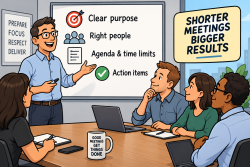
“Meetings are a symptom of bad organization. The fewer meetings the better.”
— Peter F. Drucker, management consultant and authorOne of the most frustrating activities for engineers is attending inefficient meetings.
Engineers are taught in engineering school to always use the most efficient design. Why can’t this apply to the meetings they attend?
The truth is, meetings can be more efficient if you follow the three steps below.
Prepare Before the Meeting
As an engineer, review the agenda and supporting material before the meeting, and identify the one or two decisions or outcomes you need.
Preparation shifts valuable meeting time from information transfer to problem-solving and decision-making.
If no agenda exists, ask the organizer what the meeting should accomplish and what preparation is required.
When you organize a meeting, distribute a short agenda identifying the purpose, priority topics, discussion leaders, and time allotted to each topic.
A useful method will steer the discussion in the right direction. Specify in the agenda whether each agenda item is for information, decision, or a discussion.
Information that does not require discussion, collaboration, or a decision can often be handled asynchronously, preserving engineering time for higher-value technical work.
Decision items are crucial. Decision items have to be resolved at the meeting—no delaying the decision.
Discussion items should come last because they are less crucial than information items or decision items. If you don’t have time to discuss discussion agenda items, you can cover them at the next meeting.
You should also decide whether you need to attend part of the meeting or the entire meeting. Unless the meeting is about your project and/or you have something to contribute that is crucial to the meeting, you shouldn’t attend the meeting.
One way you can make the meetings you attend more efficient is to prepare beforehand.
Another way is to keep the discussion focused.
Keep the Discussion Focused
You can help keep meetings on track by tying comments and questions directly to the stated objective.
When discussion drifts into an unrelated technical issue, suggest putting it in a “parking lot” for separate follow-up rather than letting it consume the meeting.
Use concise technical communication: problem → evidence → alternatives → recommendation.
Instead of explaining every technical detail, provide enough information for the group to understand the issue and make the required decision.
Time-box difficult topics rather than allowing one problem to consume the entire meeting.
Prioritizing important issues and controlling discussion time makes it more likely that the team addresses the matters that actually require collective attention.
Two ways engineers can make the meetings they attend more efficient are to prepare beforehand and keep the discussion focused.
A third way is to turn discussion into decisions and actions.
Turn Discussion Into Decisions and Actions
You should measure a meeting by its outputs, not its duration: What did we decide, what problem did we solve, and what happens next?
MIT Sloan specifically recommends evaluating meeting productivity by the number of decisions made and problems resolved.
Before leaving a topic, explicitly confirm the decision: “So, have we agreed that Option B is the approach we are taking?”
This simple confirmation prevents teams from discovering days later that different participants left the same meeting with different interpretations.
End meetings with clear action items that specify what will be done, who owns it, and when it is due.
Recording decisions, owners, deliverables, and deadlines converts conversation into accountable engineering work.
Three ways you can make the meetings you attend more efficient are to (1) prepare beforehand, (2) keep the discussion focused, and (3) turn discussion into decisions and actions.
Everyone hates inefficient meetings.
Meetings take time away from your engineering work. So the meetings you attend must have a clear return on investment for your project or contribute to your organization’s goals.
On the flip side, an efficiently run meeting—with a clear agenda divided into information, decision, and discussion items, a clear ROI to your project or organizational goals, and a recording so everyone is clear on the outcomes—is loved by everyone.
Your job is to ensure the meetings you must attend or run run efficiently.
Call to Action
When you organize a meeting, distribute a short agenda identifying the purpose, priority topics, discussion leaders, and time allotted to each topic. A useful method will steer the discussion in the right direction. Specify in the agenda whether each agenda item is for information, decision, or a discussion.
When meeting discussions drift into an unrelated technical issue, suggest putting it in a “parking lot” for separate follow-up rather than letting it consume the meeting.
Before leaving a topic, explicitly confirm the decision: “So, have we agreed that Option B is the approach we are taking?” This simple confirmation prevents teams from discovering days later that different participants left the same meeting with different interpretations.
“The least productive people are usually the ones who are most in favor of holding meetings.”
— Thomas Sowell, economist and author___________________________________
References
MIT Sloan School of Management — Meredith Somers, “5 Ways to Avoid Ineffective Meetings,” June 17, 2020. Recommends cataloging issues in advance and measuring meeting effectiveness through decisions made and problems solved.
Atlassian — “How to Run Effective Meetings in the Era of Hybrid Work,” February 24, 2022. Addresses agendas, meeting objectives, attendee selection, decision-making, action items, and when information should be communicated asynchronously.
Atlassian — “How to Write an Effective Team Meeting Agenda.” Recommends prioritizing agenda items, defining meeting purposes, allocating time to topics, and giving participants advance preparation time.
Atlassian — “How to Turn Meeting Action Items Into Trackable Work.” Defines effective action items around an owner, specific action, scope, expected outcome, and deadline.
Atlassian/Confluence — “Meeting Minutes Template.” Recommends documenting agenda items, decisions, action items, owners, and deadlines while using time-boxes to maintain meeting focus.
___________________________________
Being a confident, engaging, and effective STEM speaker is a vital personal and professional asset. With more than 40 years of engineering experience and more than 30 years of award-winning public speaking experience, I can help you reduce your presentation preparatory time by 50%, overcome your fear of public speaking and be completely at ease, deliver your presentations effectively, develop your personal presence with your audience; and apply an innovative way to handle audience questions deftly.
Working closely with you, I provide a customized protocol employing the critical skills and tools you need to create, practice, and deliver excellent STEM speeches and presentations. Let’s connect and explore how I can help you become the exceptional speaker you were meant to be. Please reach out to me at fr***@*****************ed.com or 703-509-4424 for a complimentary consultation. Schedule a meeting with me at calendly.com/frankdibartolomeospeaks
.©2026 DiBartolomeo Consulting International (DCI), LLC. All Rights Reserved. May not be used without permission.