
How Engineers Can Present Risk Without Sounding Alarmist
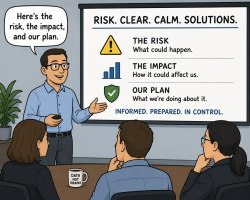
“Plans are worthless, but planning is everything.”
— Dwight D. Eisenhower, General of the Army and 34th President of the United StatesYou deal with risk every day.
You deal with risk when you drive to work. You deal with risk every time your son or daughter plays soccer. You deal with risk as an airline passenger.
And you deal with risk every day as an engineer. Risk management is part and parcel of your job.
You face major risks when you embark on hardware and/or software development. Your ability to identify, analyze, and recommend how to proceed with these risks determines your performance as an engineer.
So how can you present these risks without sounding alarmist?
Below are three ways to do this.
Quantify the Risk Instead of Dramatizing It
You should describe risk in terms of likelihood, consequence, and uncertainty, rather than emotionally charged language. Show that you have thoroughly analyzed the risk.
No other organization has had to deal with risk like the National Aeronautics and Space Administration (NASA).
NASA specifically characterizes technical risk through scenarios, likelihoods, consequences, and associated uncertainties.
Use the scientific method to analyze the risk:
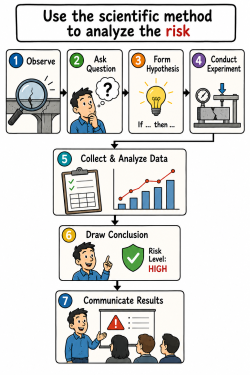
Replace statements such as “This could be disastrous” with “There is approximately a 20% probability of a four-week schedule delay.”
Numbers make the discussion more objective and give decision-makers something concrete to evaluate.
When precise probabilities are unavailable, you should clearly state the assumptions and limits behind your estimates.
Transparency about uncertainty can strengthen credibility when accompanied by useful context rather than vague disclaimers.
One way to present risk without sounding alarmist is to quantify it instead of dramatizing it.
Another way is to put the risk in the business context.
Put the Risk in Business Context
Explain what could happen, how likely it is, and what it would affect.
Connect technical risk to outcomes executives care about, such as cost, schedule, safety, reliability, performance, or customer impact.
Distinguish the most likely outcome first, then the reasonable worst case. Otherwise, executives may hear the worst case and mistakenly treat it as the expected case.
Most likely outcomes will grab executives’ attention. Remember this song lyric from the “Mary Poppins” movie: “A spoonful of sugar lets the medicine go down.”
Also, tailor the level of detail to the audience rather than burying decision-makers in probability distributions and engineering terminology.
Impact, impact, impact. This is what executives want—not engineering detail.
Executives can make decisions on impact. They can’t make decisions on engineering detail.
Research on science communication shows that even technically sophisticated audiences can struggle to interpret unfamiliar numerical and probabilistic information.
This all goes back to knowing your audience. If you don’t, why are you presenting?
Two ways to present risk without sounding alarmist are to quantify it rather than dramatize it and frame it in the business context.
A third way is to pair the risk with a recommended action.
Pair the Risk With a Recommended Action
Never stop at “Here is what could go wrong.” Follow the risk with what we can do about it, including mitigation actions, contingency plans, monitoring, and decision thresholds. Include a schedule of actions.
For example: “If supplier delivery slips beyond October 15, I recommend activating Supplier B, which should limit our schedule impact to approximately two weeks.”
This shifts you from bearer of bad news to problem-solving adviser. Executives fully realize there will be risks in any worthwhile project. What they don’t see much of are plans to mitigate the risk to its lowest likelihood.
Finally, state what decision or action you want from leadership. You will rarely have the power to approve additional budget to mitigate risks, but executives do. Your job is to convince them your recommendations will lower the likelihood the risks will be realized.
Three ways to present risk without sounding alarmist are to (1) quantify it instead of dramatizing it, (2) put the risk in the business context, and (3) pair the risk with a recommended action.
Effective risk management ultimately helps decision-makers balance uncertainty, consequences, alternatives, and mitigation—not frighten them into action.
Add the title of risk manager alongside your engineering title.
Call to Action
>You should describe risk in terms of likelihood, consequence, and uncertainty, rather than emotionally charged language. Show that you have thoroughly analyzed the risk.
Connect technical risk to outcomes executives care about, such as cost, schedule, safety, reliability, performance, or customer impact.
State what decision or action you want from leadership.
“Ultimately, even to scientists, risk is a matter of how we feel about the facts more than just what the facts tell us all by themselves.”
— David Ropeik, risk-perception consultant and former Harvard instructor___________________________________
References
NASA. NASA Systems Engineering Handbook, Section 6.4: Technical Risk Management. Defines risk through scenarios, likelihood, consequences, and uncertainties and discusses mitigation, contingency actions, trigger thresholds, monitoring, and communication. NASA Technical Risk Management
Institute of Medicine. (2013). Environmental Decisions in the Face of Uncertainty, Chapter 6, “Communication of Uncertainty.” Washington, DC: National Academies Press. DOI: 10.17226/12568. Discusses numerical, verbal, and graphical communication of probability and notes the ambiguity inherent in terms such as “likely” and “unlikely.” National Academies — Communication of Uncertainty
National Research Council. (2006). Completing the Forecast: Characterizing and Communicating Uncertainty for Better Decisions Using Weather and Climate Forecasts. Washington, DC: National Academies Press. DOI: 10.17226/11699. Explains problems with verbal probability expressions and the advantages of numerical probabilities and relative frequencies.
National Academies of Sciences, Engineering, and Medicine. (2017). Communicating Science Effectively: A Research Agenda. Washington, DC: National Academies Press. DOI: 10.17226/23674. Reviews evidence on communicating scientific uncertainty and how audiences interpret numerical and probabilistic information.
McGuire, M. (2023). Lessons Learned With Risk Management: A Systems Engineer’s Perspective. NASA Technical Reports Server. Emphasizes risk management as a communication mechanism that allows engineering teams to identify concerns early and implement mitigation before risks become failures.
___________________________________
Being a confident, engaging, and effective STEM speaker is a vital personal and professional asset. With more than 40 years of engineering experience and more than 30 years of award-winning public speaking experience, I can help you reduce your presentation preparatory time by 50%, overcome your fear of public speaking and be completely at ease, deliver your presentations effectively, develop your personal presence with your audience; and apply an innovative way to handle audience questions deftly.
Working closely with you, I provide a customized protocol employing the critical skills and tools you need to create, practice, and deliver excellent STEM speeches and presentations. Let’s connect and explore how I can help you become the exceptional speaker you were meant to be. Please reach out to me at fr***@*****************ed.com or 703-509-4424 for a complimentary consultation. Schedule a meeting with me at calendly.com/frankdibartolomeospeaks
.©2026 DiBartolomeo Consulting International (DCI), LLC. All Rights Reserved. May not be used without permission.