
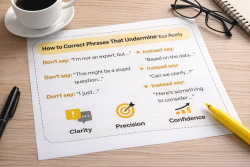
How to Correct Phrases That Undermine Your Authority
“People judge your competence by the confidence of your communication.”
— Amy Cuddy, social psychologist, Harvard Business School; author of Presence: Bringing Your Boldest Self to Your Biggest Challenges (2015)As an engineer, you are trained to be precise and cautious.
That’s good for bridges and spacecraft—but sometimes terrible for your credibility in presentations.
Below are three common phrases that can unintentionally weaken your authority and simple alternatives you can use to come across as more credible.
“I’m Not An Expert, But…”
This phrase is often used as a polite disclaimer before presenting an idea.
ou might say this to show honesty and recognize your knowledge’s limits.
Unfortunately, audiences rarely interpret it as humility—they interpret it as your uncertainty.
Undermining yourself makes listeners value your points less.
In a technical or executive environment, credibility is strongly tied to perceived confidence.
Research in communication psychology shows that audiences rely heavily on cues such as tone and framing when deciding whether information is trustworthy.
If you signal doubt before even stating the conclusion, the audience may stop paying attention to the analysis entirely.
Instead of disclaiming your expertise, acknowledge the scope while maintaining authority.
Replace the phrase with something like: “Based on the data we analyzed…” or “Our evaluation of the system indicates…”
Say, “Based on the data…” instead of apologizing or hedging first.
Avoid using the phrase “I’m not an expert, but…” when speaking publicly.
Another phrase to avoid is “This might be a stupid question…”
“This Might Be a Stupid Question…”
You may frequently say this when asking questions in meetings or during discussions with colleagues.
You might say this to avoid being confrontational.
Ironically, it signals insecurity and weakens your point.
From a communication standpoint, framing matters.
Studies in organizational behavior show that questions framed confidently are perceived as more insightful and valuable.
When you label your own question as “stupid,” listeners may assume the comment lacks substance before hearing it.
Remove apologies and ask questions directly.
For example: “Can we clarify the assumptions behind that model?” or “What constraints are driving that decision?”
Direct, neutral language positions the question as analytical rather than apologetic.
In many cases, these are exactly the questions leaders wish someone would ask.
Avoid using the phrases “I’m not an expert, but…” and “This might be a stupid question…” when speaking publicly.
A final phrase not to use is “I just…”
“I Just…”
The word “just” may often sneak into your professional communication: “I just wanted to add something,” or “I’m just checking whether this will work.”
“Just” is a minimizing word that weakens your message.
In technical presentations or executive briefings, minimizing language can dilute impact.
Research on leadership communication shows that speakers who remove hedging words are perceived as more decisive and credible.
You may often unconsciously use these modifiers to avoid appearing overly assertive.
The fix is straightforward: remove the minimizing word and state the point directly.
Instead of “I just wanted to point out a potential risk,” say “There’s a potential reliability risk in this configuration.”
The information becomes clearer, and you will appear more confident—without changing the underlying analysis.
Three common phrases you should not use when you are speaking publicly are (1) “I’m not an expert, but…”, (2) “This might be a stupid question…”, and (3) “I just…”
As an engineer, you are trained to be precise and cautious.
In your engineering work, this is laudable. However, if you try to convince someone of your engineering idea, being precise and cautious will likely backfire, leading you to lose credibility with your audience.
Identify which phrases prompt your audience to question your credibility, and consciously avoid them to maximize impact.
Take charge of your professional narrative—your career growth demands confident, authoritative communication.
Start now!
Call to Action
Instead of disclaiming your expertise, acknowledge the scope while maintaining authority.
Remove apologies and ask questions directly.
Remove your minimizing words and state your points directly.
“The way you frame a message often matters more than the message itself.”
— Daniel Kahneman, Nobel Prize–winning psychologist; author of Thinking, Fast and Slow (2011)___________________________________
References
Cuddy, Amy. Presence: Bringing Your Boldest Self to Your Biggest Challenges. Little, Brown and Company, 2015.
Gallo, Carmine. Talk Like TED: The 9 Public-Speaking Secrets of the World’s Top Minds. St. Martin’s Press, 2014.
Heath, Chip & Heath, Dan. Made to Stick: Why Some Ideas Survive, and Others Die. Random House, 2007.
Kahneman, Daniel. Thinking, Fast and Slow. Farrar, Straus and Giroux, 2011.
Duarte, Nancy. Resonate: Present Visual Stories that Transform Audiences. Wiley, 2010.
_____________________________
Being a confident, engaging, and effective STEM speaker is a vital personal and professional asset. With more than 40 years of engineering experience and more than 30 years of award-winning public speaking experience, I can help you reduce your presentation preparatory time by 50%, overcome your fear of public speaking and be completely at ease, deliver your presentations effectively, develop your personal presence with your audience; and apply an innovative way to handle audience questions deftly.
Working closely with you, I provide a customized protocol employing the critical skills and tools you need to create, practice, and deliver excellent STEM speeches and presentations. Let’s connect and explore how I can help you become the exceptional speaker you were meant to be. Please reach out to me at fr***@*****************ed.com or 703-509-4424 for a complimentary consultation. Schedule a meeting with me at calendly.com/frankdibartolomeospeaks
.