
How to Keep Your Audience Engaged During Your Technical Presentation
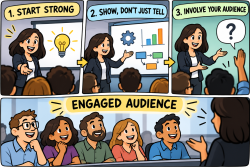
“The audience is not the enemy. They are the reason we are there.”
— Nancy Duarte, presentation expert and author of Resonate: Present Visual Stories That Transform Audiences (2010)Imagine spending weeks preparing a technical presentation, only to watch your audience lose interest within minutes. Your information may be technically brilliant, but brilliance means little if nobody is listening.
Engineers frequently present complex information to colleagues, managers, executives, and customers. Unfortunately, technical accuracy alone does not guarantee audience engagement.
An effective technical presentation must capture attention, maintain interest, and encourage action. Your challenge is to make complicated information understandable, relevant, and memorable.
Below are three ways to keep your audience engaged throughout your technical presentation.
Make Your Technical Information Relevant to Your Audience
Understand your audience before developing your presentation. Identify their technical knowledge, professional responsibilities, and primary concerns.
Why is this necessary? If you don’t know their technical knowledge, professional responsibilities, and primary concerns, you are like someone in a rowboat in the middle of the ocean. You don’t know which way to “row.”
Begin with a problem your audience wants solved. Explain how your technical information addresses their challenges, improves performance, or reduces costs.
Solving your audience’s problems will engage them. You are addressing their primary concerns.
Connect your technical findings to meaningful business outcomes. Demonstrate how your recommendations save time, reduce risk, or improve operational efficiency.
You and I are engineers. We went into engineering because we enjoy building something new. However, this likely is not the case with your audience.
What your audience wants to hear is an understanding of their problems, a solution to those problems, and evidence that your solution works. Short of this, you will lose them.
One way to keep your audience engaged throughout your technical presentation is to make your technical information relevant to them.
Another is to simplify complex information and use engaging visuals (e.g., charts, graphs, pictures, videos, etc.)
Simplify Complex Information and Use Engaging Visuals
Organize your presentation around three main points. Present information in logical sections that your audience can easily follow and remember.
The reason your presentation should be organized around three main points is that people can remember three main points. If you have two main points, your audience will feel cheated. If you have four or more points, your audience will not be able to remember them.
Replace text-heavy slides with clear, purposeful visuals. Use diagrams, charts, and illustrations that emphasize your most important technical findings.
Heavy text slides will shift your audience’s focus from you to your slides—never good. You want your audience’s focus to be on you. Make your audience work a bit. Slides with minimal text cause your audience to focus more on what you say.
Diagrams, charts, and illustrations will save you time during your presentation. They will transfer your message fast.
Explain complicated concepts using familiar language and relatable analogies. Minimize unnecessary jargon without sacrificing the technical accuracy your audience expects.
Use the “lingo” of your audience so they will understand exactly what you are saying the first time they hear it. No explanations necessary.
Two ways to keep your audience engaged throughout your technical presentation are to make your technical information relevant to them, and to simplify complex information and use engaging visuals (e.g., charts, graphs, pictures, videos, etc.).
A third way is to encourage audience participation and interaction.
Encourage Audience Participation and Interaction
Ask questions that stimulate curiosity and critical thinking. Invite audience members to consider how your information applies to their engineering challenges.
Asking your audience questions is a great way to make them think about how what you are saying applies to their lives. Your audience will also better retain what you are saying.
Use brief stories and real-world engineering examples. Describe technical problems, unexpected discoveries, and successful solutions that make your information memorable.
Everyone loves a story, including engineers. Talk about a real-world situation where you applied what you are saying.
Observe audience reactions and adjust your delivery accordingly. Change your pace, provide clarification, or invite questions when you notice declining attention.
Become an expert in interpreting your audience’s body language. They are telling you whether they are interested, intrigued, or just shutting you out.
Three ways to keep your audience engaged throughout your technical presentation are to (3) make your technical information relevant to them, (2)simplify complex information and use engaging visuals (e.g., charts, graphs, pictures, videos, etc.), and (3) encourage audience participation and interaction.
Keeping your audience engaged requires more than delivering technically accurate information. You must make your message relevant, simplify complex ideas, and encourage meaningful interaction.
The most effective technical presenters do not simply transfer information. They help their audiences understand important ideas, recognize their value, and take appropriate action.
Remember: A successful technical presentation is measured not by how much information you deliver, but by how much your audience understands and remembers.
Call to Action
Know Your Audience: Before your next presentation, identify three things your audience needs to understand and why each matters.
Simplify Your Message: Review your next technical presentation and eliminate unnecessary jargon, excessive detail, and distracting slides.
Increase Interaction: Include at least three opportunities for audience participation through questions, discussions, or practical examples.
“The single biggest problem in communication is the illusion that it has taken place.”
— Commonly attributed to George Bernard Shaw, although the attribution is unverified.___________________________________
References
Alley, Michael. (2013). The Craft of Scientific Presentations: Critical Steps to Succeed and Critical Errors to Avoid. 2nd Edition. Springer. Explains how scientists and engineers can structure technical presentations, design effective visuals, and communicate complex material clearly.
Mayer, Richard E. (2021). Multimedia Learning. 3rd Edition. Cambridge University Press. Describes evidence-based principles for combining words and graphics to improve audience understanding and learning.
Duarte, Nancy. (2010). Resonate: Present Visual Stories that Transform Audiences. John Wiley & Sons. Explores audience-centered storytelling, presentation structure, and techniques for making messages compelling.
Heath, Chip, and Heath, Dan. (2007). Made to Stick: Why Some Ideas Survive and Others Die. Random House. Introduces six principles for making ideas memorable, including simplicity, concreteness, credibility, and stories.
Kosslyn, Stephen M. (2007). Clear and to the Point: 8 Psychological Principles for Compelling PowerPoint Presentations. Oxford University Press. Applies cognitive psychology to designing slides that direct attention, reduce confusion, and improve comprehension.
Freeman, Scott, et al. (2014). “Active Learning Increases Student Performance in Science, Engineering, and Mathematics.” Proceedings of the National Academy of Sciences, 111(23), 8410–8415. https://doi.org/10.1073/pnas.1319030111. Provides research supporting active participation as an effective learning strategy in STEM education, with principles that can inform interactive technical presentations.
___________________________________
Being a confident, engaging, and effective STEM speaker is a vital personal and professional asset. With more than 40 years of engineering experience and more than 30 years of award-winning public speaking experience, I can help you reduce your presentation preparatory time by 50%, overcome your fear of public speaking and be completely at ease, deliver your presentations effectively, develop your personal presence with your audience; and apply an innovative way to handle audience questions deftly.
Working closely with you, I provide a customized protocol employing the critical skills and tools you need to create, practice, and deliver excellent STEM speeches and presentations. Let’s connect and explore how I can help you become the exceptional speaker you were meant to be. Please reach out to me at fr***@*****************ed.com or 703-509-4424 for a complimentary consultation. Schedule a meeting with me at calendly.com/frankdibartolomeospeaks
.©2026 DiBartolomeo Consulting International (DCI), LLC. All Rights Reserved. May not be used without permission.