
The Mistake of Explaining the Technology Instead of the Problem
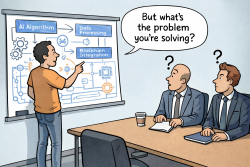
“People don’t want to buy a quarter-inch drill. They want a quarter-inch hole.”
— Theodore Levitt, Harvard Business Review, 1960When presenting to investors or prospective clients, startups often start with sexy technology which is not the concern of investors and prospective clients.
Investors and prospective clients are interested in how the pitched service or product will solve a meaningful problem.
Below are three ways startups can shift their delivery from explaining the technology to explaining how their service or product will solve meaningful problems:
Start With the Problem the Customer Feels
Many technical founders instinctively begin presentations by describing how their technology works. They discuss the architecture, algorithms, frameworks, or engineering breakthroughs behind their service or product.
While this information may be impressive, it often fails to engage the audience immediately. Most customers and investors are not primarily interested in the technology’s mechanics; they are interested in whether the service or product solves a meaningful problem.
Effective communication starts with the customer’s pain point. A presentation should first answer the question: What problem exists that people care enough to fix?
When audiences recognize their own challenges in the description, they become attentive. The problem provides the context that makes the technology relevant.
Once the problem is clearly established, the technology becomes easier to appreciate.
Instead of sounding like a technical curiosity, the product becomes a practical solution to a costly or frustrating issue.
By starting with the problem, founders align their explanation with the audience’s priorities rather than their own engineering excitement.
One way startups can shift their delivery from explaining the technology to explaining how their service or product will solve meaningful problems is to start with the problem the customer feels.
Another is to realize technology is only valuable when it produces results.
Technology Is Only Valuable When It Produces Results
Technical founders often emphasize the novelty or sophistication of their technology. However, customers rarely purchase products simply because they are technically elegant.
They purchase products because those products deliver measurable results such as increased revenue, reduced risk, faster processes, or improved reliability.
When startups focus too heavily on describing the technology itself, they unintentionally obscure the real value of their product.
Complex explanations of algorithms, infrastructure, or system design can overwhelm listeners who simply want to know how the technology will improve their situation. Without clear outcomes, the audience may struggle to see why the solution matters.
Successful startups translate technical capabilities into business impact. Instead of explaining every feature, they describe what those features accomplish.
For example, rather than discussing a machine learning model in technical detail, a founder might explain how the system reduces fraud losses or improves operational efficiency. The audience understands the value because the outcome is clear.
Two ways startups can shift their delivery from explaining the technology to explaining how their service or product will solve meaningful problems is to start with the problem the customer feels, and realize technology is only valuable when it produces results.
A final way for startups to shift their delivery from explaining the technology to explaining how their service or product will solve meaningful problems is to use clear problem framing, which creates persuasion.
Clear Problem Framing Creates Persuasion
Human decision-making is strongly influenced by problem recognition. When audiences clearly understand a problem and its consequences, they become far more receptive to solutions.
For this reason, persuasive communication often begins with a careful explanation of what is going wrong and why it matters.
If a startup jumps directly into technology descriptions, the audience may not yet understand the significance of the solution.
Without recognizing the seriousness of the problem, listeners may perceive the product as unnecessary or overly complex.
By contrast, when the problem is framed clearly—especially when the cost of ignoring it is explained—the solution becomes compelling.
Effective founders therefore structure their message around a simple sequence: problem, consequences, and solution. This approach mirrors how people naturally process decisions.
Once the audience understands the problem and its impact, the technology is no longer the center of attention; it becomes the logical tool for resolving the issue.
Three ways startups can shift their delivery from explaining the technology to explaining how their service or product will solve meaningful problems is to:
Start with the problem the customer feels.
Realize that technology is only valuable when it produces results.
Use clear problem framing to create persuasion.
By focusing your presentations on the most pressing customer problems, you will solve the very issues the customer has not been able to.
his will make your presentation compelling. You want prospective customers to be asking themselves, “What harm will come if we don’t go with this startup’s solution?”
Call to Action
Start your presentation with the customer’s pain point. A presentation should first answer the question: What problem exists that people care enough to fix?
Translate technical capabilities into business impact. Instead of explaining every feature, describe what those features accomplish.
Structure your message around a simple sequence: problem, consequences, and solution. This approach mirrors how people naturally process decisions.
“People don’t want technology. They want solutions to their problems.”
— Don Norman, The Design of Everyday Things, Basic Books, 2013___________________________________
References
Blank, S., & Dorf, B. (2012). The Startup Owner’s Manual. K&S Ranch Press.
Christensen, C. M., Hall, T., Dillon, K., & Duncan, D. S. (2016). Competing Against Luck: The Story of Innovation and Customer Choice. Harper Business.
Ries, E. (2011). The Lean Startup. Crown Business.
Heath, C., & Heath, D. (2007). Made to Stick: Why Some Ideas Survive and Others Die. Random House.
Gallo, C. (2014). Talk Like TED: The 9 Public-Speaking Secrets of the World’s Top Minds. St. Martin’s Press.
_____________________________
Being a confident, engaging, and effective STEM speaker is a vital personal and professional asset. With more than 40 years of engineering experience and more than 30 years of award-winning public speaking experience, I can help you reduce your presentation preparatory time by 50%, overcome your fear of public speaking and be completely at ease, deliver your presentations effectively, develop your personal presence with your audience; and apply an innovative way to handle audience questions deftly.
Working closely with you, I provide a customized protocol employing the critical skills and tools you need to create, practice, and deliver excellent STEM speeches and presentations. Let’s connect and explore how I can help you become the exceptional speaker you were meant to be. Please reach out to me at fr***@*****************ed.com or 703-509-4424 for a complimentary consultation. Schedule a meeting with me at calendly.com/frankdibartolomeospeaks
.