
The Problem of Jargon and How to Fix It
“Jargon is a shortcut for insiders but a barrier for everyone else; clarity begins where exclusion ends.”
— AnonymousToo much jargon is the silent killer of great ideas. What sounds precise to you can sound like noise to everyone else, creating confusion instead of clarity.
When audiences have to decode your language, they stop listening—and once they stop listening, they stop caring.
The fix is simple but not easy: translate, don’t impress. Replace technical terms with clear outcomes, relatable analogies, and plain language.
Lead with the problem, not the terminology. If your audience understands you quickly, they trust you faster—and that’s where real influence begins.
Below are three negative things jargon does and strategies for fixing the problem of too much jargon:
Jargon Creates Cognitive Friction (a.k.a. “You lost them at API”)
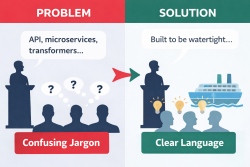
When speakers overload an audience with terms like APIs, microservices, or transformers, they unintentionally increase cognitive load.
Non-technical listeners must translate every term before they can understand the idea. That translation step slows comprehension—and attention drifts fast. Once the audience falls behind, they rarely catch up.
This problem is not about intelligence—it’s about context. Engineers operate in high-density language environments where shorthand is efficient.
But outside that environment, the same shorthand becomes noise. The audience isn’t rejecting the idea; they’re struggling to decode the language.
Replace jargon with plain-language equivalents first, then layer in the technical term. For example: “Think of an API as a waiter in a restaurant—it takes your request, brings it to the kitchen, and delivers the result.”
Now the audience has a mental model. Once grounded, you can safely introduce the technical label without losing them.
One effect of jargon is that it creates cognitive friction and, therefore, increases cognitive load.
Another effect of jargon is that it shifts focus from value to mechanism.
Jargon Shifts Focus from Value to Mechanism
Technical speakers often default to explaining how it works rather than why it matters.
Terms like distributed architecture or transformer models emphasize internal mechanics, but most audiences care about outcomes—speed, cost, reliability, or risk reduction.
Jargon pulls attention away from value and into abstraction.
This creates a subtle but critical disconnect: the audience hears complexity instead of benefit.
Complexity signals effort; benefit signals relevance. If people don’t quickly see why something matters, they mentally disengage—even if the technology is brilliant.
Lead with impact, not implementation. Translate every technical concept into a business or human consequence.
For instance: instead of “We use microservices,” say “We built the system so one failure doesn’t bring everything down—like watertight compartments on a ship.”
Now the audience understands resilience before hearing architecture.
Two effects of jargon are that it creates cognitive friction, thereby increasing cognitive load, and shifts focus from value to mechanism.
A third effect of jargon is that it weakens authority rather than strengthens it.
Jargon Weakens Authority Rather Than Strengthens It
Many speakers believe jargon signals expertise. Ironically, overuse often does the opposite.
If the audience cannot understand you, they may assume either that the idea is unclear or that you are. Clarity, not complexity, builds credibility with mixed audiences.
Strong communicators are translators, not just experts. The ability to explain complex ideas simply demonstrates mastery.
As Einstein famously implied, “If you can’t explain it simply, you don’t fully understand it.” Audiences trust those who make them feel smart—not those who make them feel excluded.
Apply the “Explain It to a Smart 12-Year-Old” test. Strip your explanation to its essence, using analogies, simple language, and concrete examples.
Then, selectively reintroduce key technical terms once understanding is established. Precision comes after clarity—not before.
Three effects of jargon are that it (1) creates cognitive friction, thereby increasing cognitive load, (2) shifts focus from value to mechanism, and (3) weakens authority rather than strengthens it.
Strike your jargon from your narrative to more fully engage your audience.
After all, delivering a technical presentation is not about impressing your audience; it is about transferring readily understandable information that your audience can and wants to implement immediately.
The bottom line is that if your audience needs a glossary, you’re in trouble. If they say, “That makes sense,” you’re in business.
Call to Action
Replace jargon with plain-language equivalents first, then layer in technical terms.
Lead with impact, not implementation. Translate every technical concept into a business or human consequence.
Selectively reintroduce key technical terms once understanding is established.
“Every unnecessary buzzword is a small act of hiding; plain language is an act of trust.”
— Lina Chen, UX Researcher___________________________________
References
Sweller, J. (1988). Cognitive Load During Problem Solving: Effects on Learning. Cognitive Science, 12(2), 257–285.
Kahneman, D. (2011). Thinking, Fast and Slow. Farrar, Straus and Giroux.
Pinker, S. (2014). The Sense of Style: The Thinking Person’s Guide to Writing in the 21st Century. Viking.
Heath, C., & Heath, D. (2007). Made to Stick: Why Some Ideas Survive and Others Die. Random House.
Miller, D. (2017). Building a StoryBrand: Clarify Your Message So Customers Will Listen. HarperCollins.
Gallo, C. (2014). Talk Like TED: The 9 Public-Speaking Secrets of the World’s Top Minds. St. Martin’s Press.
Feynman, R. (1985). Surely You’re Joking, Mr. Feynman!. W.W. Norton & Company.
Siegel, A., & Etzkorn, I. (2013). Simple: Conquering the Crisis of Complexity. Twelve.
Keller, S., & Meaney, M. (2017). Leading Organizations: Ten Timeless Truths. Bloomsbury / McKinsey & Company.
Harvard Business Review. (2016). The Power of Simple Language (and related articles on clarity and executive communication).
_____________________________
Being a confident, engaging, and effective STEM speaker is a vital personal and professional asset. With more than 40 years of engineering experience and more than 30 years of award-winning public speaking experience, I can help you reduce your presentation preparatory time by 50%, overcome your fear of public speaking and be completely at ease, deliver your presentations effectively, develop your personal presence with your audience; and apply an innovative way to handle audience questions deftly.
Working closely with you, I provide a customized protocol employing the critical skills and tools you need to create, practice, and deliver excellent STEM speeches and presentations. Let’s connect and explore how I can help you become the exceptional speaker you were meant to be. Please reach out to me at fr***@*****************ed.com or 703-509-4424 for a complimentary consultation. Schedule a meeting with me at calendly.com/frankdibartolomeospeaks
.